
Before you go further
- Inside the CBRS, most new federal spending and assistance, including NFIP flood insurance, is prohibited.
- The CBRS Mapper’s Validation Tool tells you whether an address is in or out.
- A federally insured lender may still lend on a home that cannot get NFIP coverage.
Most beach buyers learn about flood zones. Far fewer have heard of the Coastal Barrier Resources System, and on some stretches of coast it matters more. A house can be ordinary-looking, on an ordinary street, and still sit inside an area where the federal government will not sell new flood insurance. Finding that out after you are under contract is expensive. Finding it out before you make an offer takes a few minutes.
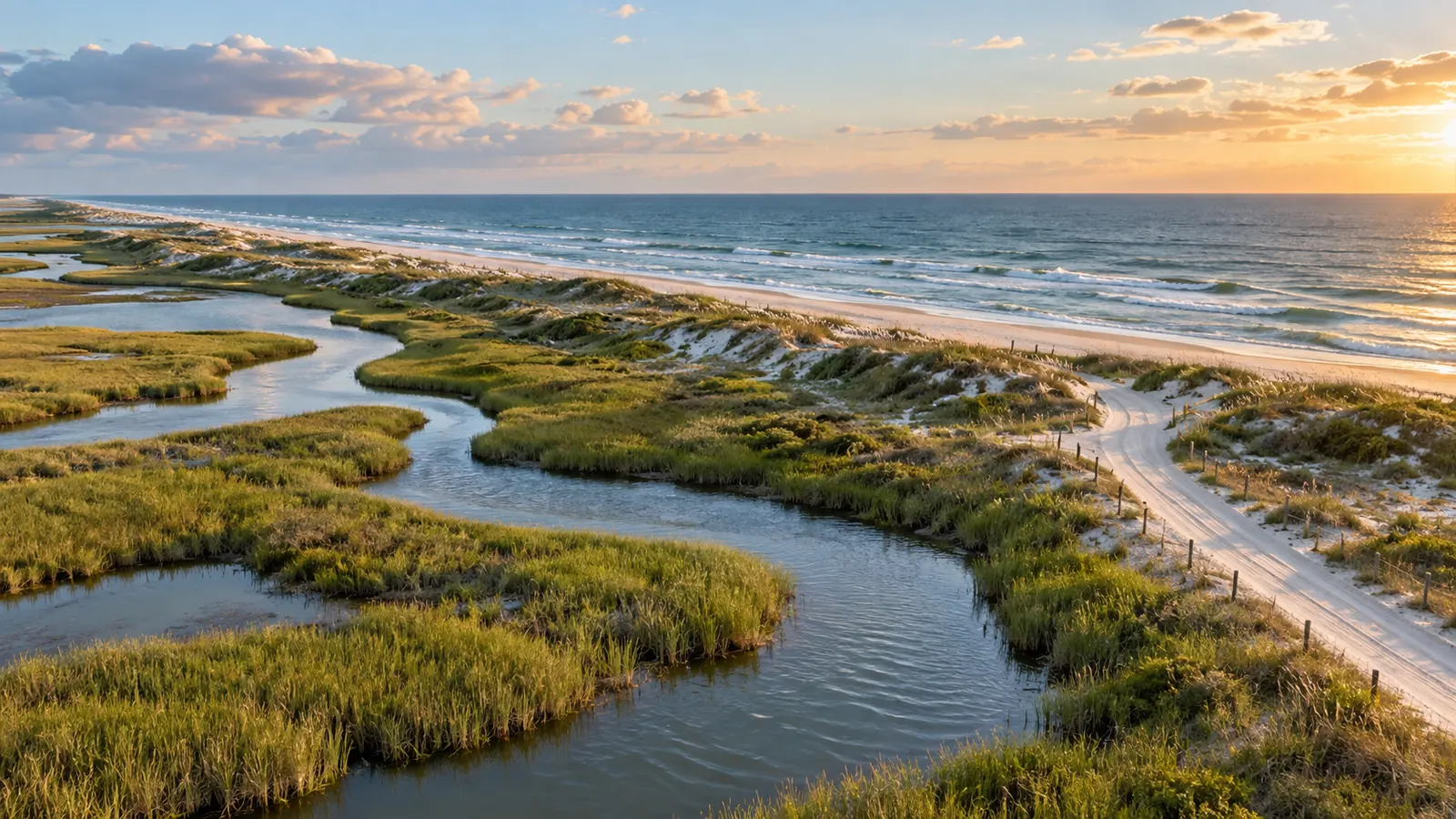
What the CBRS is
The Coastal Barrier Resources Act, passed in 1982, set up the John H. Chafee Coastal Barrier Resources System. The U.S. Fish and Wildlife Service, which administers the law, describes it as about 3.8 million acres along the Atlantic, the Gulf, the Great Lakes, the U.S. Virgin Islands and Puerto Rico. The idea is simple: these storm-prone, shifting coastal barriers are left without federal money, so taxpayers are not underwriting development there.
It is not a ban on building. In the Service’s words, the law does not prohibit or regulate development done with non-federal funds. Homes exist inside the system. What changes is which federal programs will touch them.
What is off the table inside it
Within the CBRS, most new federal expenditures and financial assistance are prohibited, and that explicitly includes flood insurance through FEMA’s National Flood Insurance Program. Under 42 U.S.C. 4028, no new NFIP coverage may be provided on or after October 1, 1983 for new construction or substantial improvements of structures on a coastal barrier within the system. Areas added later carry their own prohibition dates.
The maps also show a second, related category called Otherwise Protected Areas. The same section of law bars new NFIP coverage there for new construction and substantial improvements after November 1991, except for buildings used in keeping with the area’s protected purpose.
Tip: Federal disaster relief is also mostly unavailable within System Units of the CBRS, according to the Fish and Wildlife Service. Think about how you would rebuild after a storm before you buy.
What it means for your loan
Buyers often assume no flood insurance means no mortgage. The law is more specific. Section 4028 says a federally insured financial institution may make loans secured by structures that are not eligible for flood insurance because of this rule. Whether a particular lender will do so, and on what terms, is a separate question, so raise it with lenders as soon as you know the address is inside the system. See Financing a Second Home at the Beach for the other questions a second-home lender will ask.
How to check an address
The Fish and Wildlife Service maintains the official maps and a public CBRS Mapper. Inside it is a self-serve Validation Tool. Anyone, including property owners, real estate agents and surveyors, can select a location and download a document called CBRS Mapper Documentation that says whether the location is inside or outside the system. For a location inside, it also shows the date the federal flood insurance prohibition took effect.
- Look up the exact parcel, not just the street or the beach name.
- Save the CBRS Mapper Documentation with your purchase papers.
- If the house sits within about 20 feet of a boundary, the tool will not decide; ask the Service for a CBRS Property Determination letter.
- Check the date on any map you rely on. The Service adopted revised maps for 89 units in December 2024, and boundaries can change.
Questions to ask before you offer
- When was this house built, and has it been substantially improved since the prohibition date for this unit?
- Does the seller have flood coverage today, and from whom? A private policy is a different product from the NFIP.
- What would private flood coverage cost for this address, and is it available at all?
- Will my lender make the loan without NFIP coverage?
- How might the next buyer see this when I sell?
That last question matters for a beach home in particular. Some buyers may hesitate over a house that cannot get NFIP coverage, and some lenders may be more cautious. That does not make the house a bad buy, but it belongs in your price and in your plans. Our guide to Insuring a Beach Home: Homeowners, Wind and Flood Coverage covers how wind and flood coverage fit together.
Keep it in proportion
The point is not to fear the system but to know where the line runs before you sign. Pair this check with the flood zone on FEMA’s map, explained in Flood Zones Explained for Beach Home Buyers, and you will know the two facts that shape a coastal purchase more than any view. Keep both documents with your closing papers; the next buyer will ask for them too.